

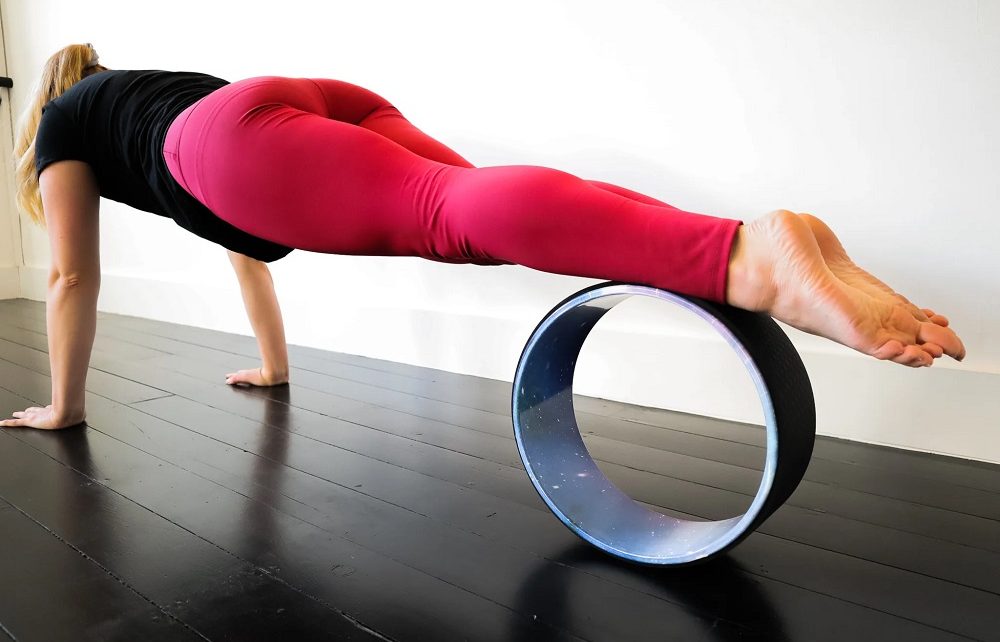
Climbers and swimmers spend substantial training time with the arms overhead or in front of the body. They may seek more shoulder and upper-back extension without recognising when the lower back and ribs create most of the visible range. A yoga wheel can provide useful support for exploring extension, provided it is used to study movement rather than force a deeper backbend.
The wheel does not replace sport-specific strength, technique or conditioning. Its value lies in slowing the task and making contact patterns easier to notice.
Climbers and Swimmers Need Different Transfers
Climbing involves gripping, pulling, overhead reaching and managing body position against the wall. Swimming uses repeated shoulder cycles while the trunk transfers force through the water.
Both activities require overhead capacity, but their technical demands are not identical. A wheel exercise should not be described as direct practice for a swimming stroke or climbing move.
Instead, it can provide general exposure to shoulder movement, upper-back extension and trunk control. The athlete must still develop those qualities within the sport.
The transfer is a movement option, not a copied technique.
Rib Lift Can Imitate Shoulder Range
When the arms move overhead, the ribs may lift and the lower back may extend. This increases the apparent reach even if shoulder movement has stopped.
Some trunk movement is normal. The goal is not to hold the ribs completely fixed.
The useful question is whether the athlete can choose how much the trunk contributes. If the ribs move abruptly whenever the arms travel overhead, control may be limited.
The wheel can support the upper back while the athlete explores a smaller arm range with clearer organisation.
Begin With Sport Fatigue in Mind
Climbers may arrive with fatigued fingers, forearms and pulling muscles. Swimmers may carry substantial shoulder and upper-back volume.
Wheel work involving arm support or deep overhead range can add load to already tired areas. The session should reflect recent training.
After a high-volume climbing or swim session, the athlete may use more support, reduce arm range or focus on breathing in a modest extension.
A demanding wheel session is not automatically recovery simply because it differs from the sport.
Use Upper-Back Contact Before Full Extension
A practical progression begins with the wheel supporting the upper back while the feet remain grounded. The hips can stay relatively low.
The athlete can first learn where the prop contacts the body. Arms may remain near the torso or support the head.
If breathing remains comfortable, one or both arms can move through a manageable range. The movement should stop before the ribs lift sharply or the shoulder feels pressured.
This separates the overhead task from the desire to create a dramatic backbend.
Train Arm Movement Independently
The wheel can also be used in kneeling or seated positions. The hands or forearms rest on the prop while it rolls forward slightly.
For climbers, this may reveal whether reaching overhead causes the trunk to collapse or the shoulders to lose control. For swimmers, it can provide a slower environment for observing the relationship between arm movement and rib position.
The range should remain controlled and reversible. More rolling distance is not necessarily better.
Elbow and hand placement can be adjusted according to comfort.
Avoid Passive Hanging at End Range
Athletes may tolerate strong sensations and assume that passive pressure is useful. Allowing body weight to hang through the shoulders at maximum range may produce a large stretch without demonstrating active control.
The athlete should retain enough muscular involvement to exit smoothly. If the arms feel numb, unstable or sharply painful, the position should stop.
A supported hold can remain gentle. Its purpose is to explore extension, not test joint tolerance.
Athletes with persistent shoulder symptoms should obtain appropriate professional assessment.
Connect the Observation to Sport Training
After the wheel session, the athlete can revisit a simple sport-relevant movement.
A climber might perform an unloaded overhead reach or controlled scapular movement. A swimmer might examine a streamlined position without forcing the arms together.
The question is whether the athlete can access the desired shoulder and upper-back position with less unnecessary spinal extension.
The wheel pose itself does not need to be reproduced during sport. It supplies information that can guide other training.
Place Wheel Work Carefully
A longer extension session may be better placed after a light sport day or before scheduled recovery. Immediately before an important climb or swim set, athletes usually need preparation that feels stable and familiar.
A possible weekly arrangement might use brief wheel work after moderate training and a longer session away from priority performance.
Monitor how the shoulders and back feel during the next sport session. If stability or confidence is reduced, change the range, timing or duration.
Recovery and mobility methods should support performance rather than compete with it.
Measure Progress Through Choice
At Yoga Edition, climbers and swimmers can use wheel classes to explore extension with instructor guidance on rib movement, shoulder range and prop position.
Progress may involve reaching overhead with less abrupt trunk movement, maintaining steadier breathing or leaving the wheel more smoothly. A deeper curve is only one possible change and often not the most relevant one.
Climbers and swimmers already train substantial overhead movement. Wheel practice should help them understand how that movement is shared between the shoulders, upper back and trunk. When control guides the range, extension becomes a usable option rather than a shape created mainly by the most mobile part of the spine.


