Triathletes represent one of the most training-sophisticated member segments in any fitness market. They manage multiple disciplines simultaneously, follow structured periodisation plans, and make deliberate decisions about where to invest their limited training time. The fact that a growing proportion of Singapore’s triathlon community has incorporated group spin studio sessions into their training plans, in some cases replacing solo trainer rides that most training plans prescribe, reflects a genuine assessment of what the spin studio format offers over home-based alternatives.
The reasons are practical, physiological, and social, and they speak directly to the specific challenges of triathlon training in Singapore’s environment.
Triathletes who have made this shift consistently cite the spin studio Singapore environment as producing training outcomes that their home trainer sessions were not reliably delivering, despite the greater programme control that solo training theoretically offers.
The Motivation and Effort Problem With Solo Training
The most honest assessment of why triathletes shift from solo trainer sessions to spin studios is the effort gap. A triathlete on a home trainer, following a structured interval programme with no social context and no coach, consistently underdelivers on prescribed intensity relative to the same session in a coached group environment.
This is not a personal failing. It is a well-documented psychological phenomenon: perceived exertion rises faster in isolation than in group settings at equivalent objective output. The same interval that is completed at target power in a spin class will be curtailed slightly, or exited slightly early, on a home trainer where there is no social accountability and no instructor maintaining the energy of the session.
Over weeks and months, this consistent small gap in effort delivery accumulates into a meaningful training deficit. The triathlete following a 12-week cycling build on a home trainer is often producing less cumulative training stress than the plan prescribes. The same athlete attending two spin studio sessions per week within the same plan often exceeds the prescribed intensity because the group environment and instructor drive effort upward rather than allowing the subtle downward drift that solo training enables.
The Quality of High-Intensity Interval Work
For triathlon cycling development, VO2 max intervals and sweet spot training are the highest value sessions in any periodised plan. These efforts require sustained output at 88 to 105 percent of FTP for defined durations, with precise recovery management between repetitions.
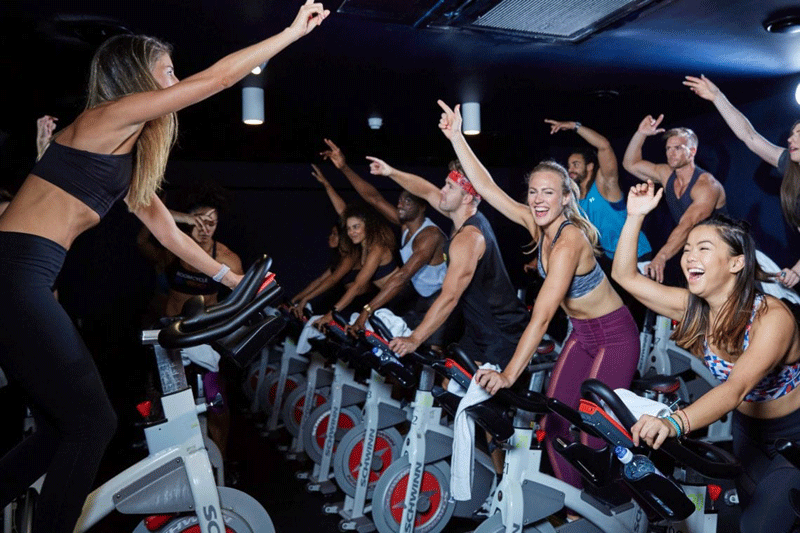
Spin studio sessions structured around these intensity targets, with a skilled instructor driving the group through the prescribed effort levels, produce a higher-quality interval stimulus than most triathletes achieve alone. The social accountability of the group, combined with the instructor’s ability to maintain effort levels during the hardest segments, consistently produces better interval execution than self-directed training.
Recovery From Singapore’s Heat and Outdoor Training Load
Singapore’s triathlon training environment includes significant outdoor run and swim volume in heat and humidity that creates substantial physiological stress beyond the training stimulus itself. Managing cumulative fatigue across three disciplines in this environment requires that some training load be achieved in conditions that reduce the thermal stress component.
Indoor cycling in an air-conditioned spin studio provides a training environment where the cardiovascular and muscular stimulus of a cycling session is delivered without the additional thermal cortisol load of outdoor riding. For triathletes managing high overall training volumes, this allows more effective total load management: the same training outcome with less systemic stress.
Community and Psychological Recovery
Triathlon training is predominantly solitary. Swim sessions are shared but largely individual. Run training, particularly the longer sessions, is often done alone. The social isolation of high-volume multi-sport training is a genuine psychological challenge, particularly for athletes managing demanding professional schedules in Singapore.
Spin studio sessions provide the social and community dimension that triathlon training typically lacks. The shared effort, the instructor-member relationship, and the camaraderie of a group training environment provide psychological renewal that contributes to overall training sustainability over a full race preparation cycle.
FAQ
Should triathletes follow the spin class programme or use the bike for their own interval sessions?
The best approach depends on the phase of training and the specific class format. During base-building periods, attending Zone 2 focused classes or riding at personal Zone 2 during a standard class provides excellent base development. During intensity phases, classes with structured interval work can align well with training plan requirements. Communicating with the instructor about your training goals can help you adapt the class session to your specific needs.
Can spin studio training replace outdoor cycling for triathlon preparation?
For most of the training year, indoor sessions can cover the physiological development goals of cycling training effectively. Sport-specific outdoor riding, including handling skills, pacing judgment on varied terrain, and race-position specific fitness, requires outdoor time that cannot be fully replicated indoors. A practical model combines indoor sessions for structured physiological development with outdoor rides for sport-specific preparation as the race approaches.
How do I find spin classes in Singapore that are appropriate for triathlon cycling development?
Look for studios that offer power-based classes with defined zone targets rather than purely motivation-driven formats. Classes described as endurance rides, threshold sessions, or performance cycling are more likely to align with triathlon training goals than rhythm-based or choreography-focused formats.
Is it appropriate to use a power meter bike in a spin class to follow a specific training plan interval rather than the class programme?
In many studios this is acceptable, particularly during less structured sessions. It is considerate to inform the instructor in advance and to ensure that your training does not disrupt the class dynamic for other participants. Some studios offer open riding sessions specifically for this purpose.
TFX Singapore provides the equipment quality, instructor expertise, and session structure that makes its spin classes genuinely useful for performance-oriented athletes including triathletes integrating studio sessions into structured training plans.